What is SEO?
SEO, or search engine optimisation, is the work of earning unpaid visibility in search: making sure Google, Bing and AI tools can find your pages, understand them, and trust them enough to show them when your buyers search. It covers three areas: the technical health of the site, the content on each page, and the reputation the site earns from other websites.
 Written by Aniket, founder of Oftsaid. Updated 16 November 2026. 4 min read.
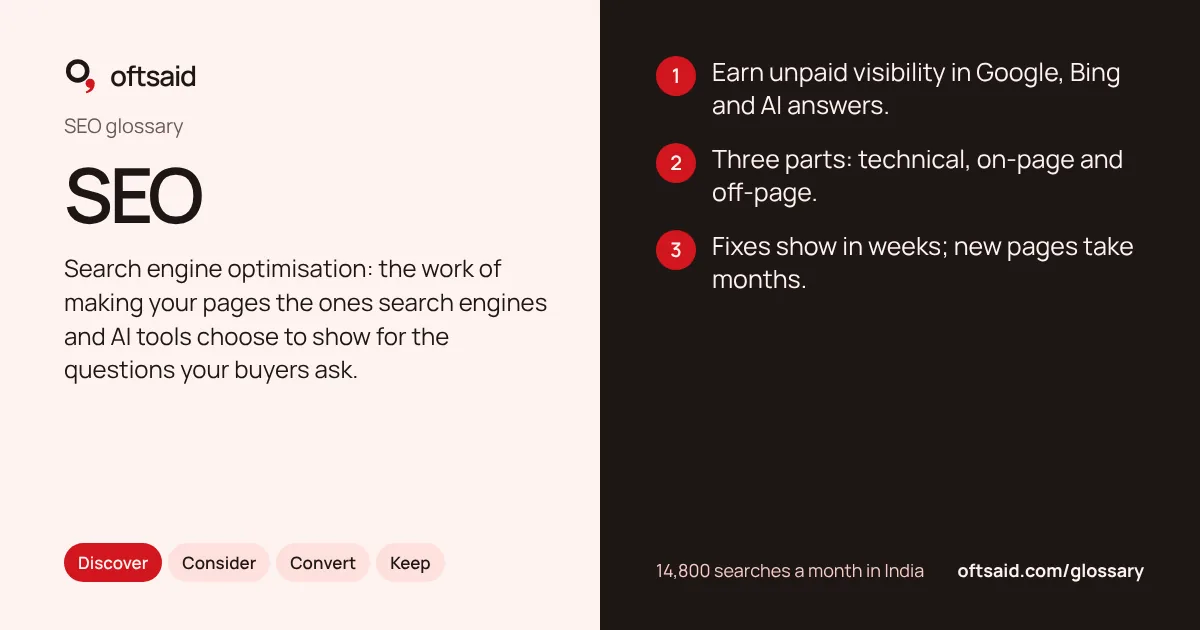
Where SEO sits in the buying journey
Topic: SEO
How it connects to other terms
What are the three parts of SEO?
- Technical SEO: can search engines crawl, render and index your pages quickly? Speed, sitemaps, redirects and structure live here.
- On page SEO: does each page answer one question well, with a clear title, headings, copy, images and internal links?
- Off page SEO: do other sites mention and link to you? Backlinks, reviews, directory listings and press coverage all count.
Most sites that struggle are weak in one of the three, not all of them. A fast site with thin pages will not rank, and neither will great writing on a site Google cannot index.
How many people search for SEO?
About 14,800 searches a month in India and 40,500 in the US, for the phrase "what is seo", according to Semrush keyword data from November 2026.
Interest in India has been falling over the last 12 months. Ranking for it in India is held by established sites, so newer sites do better targeting longer questions around it (Semrush difficulty 86 out of 100). Advertisers bidding on it in India pay about $0.07 per click on Semrush estimates, which tells you there is commercial intent behind the search.
| Market | Monthly searches | Difficulty (0 to 100) |
|---|---|---|
| India | 14,800 | 86 |
| United States | 40,500 | 85 |
India, last 12 months
Source: Semrush keyword data for India and the US, November 2026. Volumes are estimates and change month to month.
How does SEO actually work?
Search engines run three steps. They crawl the web by following links, index what they find so it can be retrieved, then rank the indexed pages for each query using hundreds of signals, with relevance, quality and trust at the centre.
AI search adds a fourth step. Tools such as Google's AI Overviews and ChatGPT read the pages that rank and quote the clearest ones. That is why answer first writing now matters as much as rankings. Our AEO entry covers that side.
How long does SEO take to work?
Fixes to pages that already exist often show within four to eight weeks. New pages on a young site usually take three to six months to settle. Anyone promising page one in a fortnight is either targeting a phrase nobody searches or not telling you the truth.
Search Console is where you see it happen first: impressions rise before clicks, and clicks rise before leads.
What does SEO cost in India?
It depends on how many hours the goal needs, not on a package name. A focused local site needs far less work than a B2B company chasing national terms against established competitors. Our SEO pricing guide shows what each budget realistically buys, and the SEO traffic value calculator shows what your rankings would cost if you bought the same clicks as ads.
How does SEO change with AI search?
AI tools such as ChatGPT, Perplexity and Google's AI Overviews do not replace SEO; they build on it. They read pages that search engines already trust, then quote the clearest ones. So the basics still decide who gets mentioned: indexable pages, a direct answer near the top, precise facts, and mentions on other trusted sites.
What changes is the reward. A ranking used to mean a click. Now it can also mean being named inside the answer itself, which is why we track citation share alongside rankings.
What do most SEO definitions leave out for Indian businesses?
They explain the theory with American examples and skip the economics. In India the commercial value of a search is far lower per click, which changes the maths: Semrush puts the cost per click for 'what is seo' at about $0.07 in India against $2.19 in the US. Cheap clicks make ads tempting, but they also mean SEO has to win on volume and intent, not on a few expensive clicks.
Three things decide whether SEO pays for a small or mid sized Indian business:
- Local intent is everywhere. Many service searches show a map pack, so a complete Google Business Profile is part of SEO, not a separate job.
- Mobile is the default. Most searches come from phones on mixed networks, so a page that loads slowly on 4G loses before content is even read.
- Buyers mix languages. Queries switch between English and Hindi or Marathi, and the results page, not the keyword tool, shows what format wins.
Our decision rule: if your buyers search for what you sell and the top results are beatable on usefulness, SEO is worth a 90 day test. If nobody searches for it yet, start with content and partnerships instead.
We read the five pages ranking for this term in November 2026 before writing this section. It covers what none of them did.
What is an example?
A payroll software company in Pune ranks only for its own name. A keyword research pass finds 30 questions finance heads type before buying. The team fixes slow templates and missing titles first, then writes one page per question with clear answers, and earns mentions on two comparison sites. Six months later the site ranks for questions buyers ask, not just for the brand, and the demo form starts filling from search.
What else do people ask about SEO?
Is SEO free?
The clicks are free, the work is not. You pay in time, people or an agency, but you do not pay per visit the way you do with ads.
Is SEO dead because of AI?
No. AI tools read and quote the pages that search engines already trust, so SEO is the entry ticket to AI answers as well.
Can I do SEO myself?
Yes, for a small site. Start with Search Console, fix what it flags, and write one strong page per real customer question.
Which terms should you read next?
Picked from the same topic and the terms this page links to.